


We Started Building Infrastructure Past It.
There’s a quiet shift happening in AI.
It’s not about chatbots getting better at writing emails.
It’s not about viral demos.
It’s not even about model benchmarks.
The real shift is architectural.
We moved from AI as a tool to AI as infrastructure.
And infrastructure changes everything.
The Brain: The Model
At the center of modern AI systems is the model — the reasoning engine.
Today’s leading models can:
-
Perform multi-step reasoning
-
Analyze codebases
-
Generate structured plans
-
Decompose complex objectives
-
Maintain long-context strategic threads
-
Evaluate and refine their own outputs
Twelve months ago, coherent paragraphs felt impressive.
Now models can scaffold applications, simulate financial scenarios, draft legal structures, and coordinate toolchains with structured logic.
This isn’t magic.
It’s the compounding effect of:
-
Larger context windows
-
Better training techniques
-
Reinforcement learning from feedback
-
Improved reasoning capabilities
-
Structured tool invocation
The intelligence curve hasn’t been linear. It has steepened.
But intelligence alone doesn’t change industries.
Execution does.
The Body: Execution Layers
A reasoning engine without action is just a consultant.
Modern AI systems can now:
-
Write and execute code
-
Call APIs
-
Query databases
-
Modify documents
-
Analyze spreadsheets
-
Deploy services
-
Interact with external software systems
This is the execution layer — the “body.”
The breakthrough wasn’t that AI could generate text.
The breakthrough was when models could reliably:
-
Decide which tool to use
-
Call that tool in a structured way
-
Interpret the result
-
Iterate toward completion
That’s when AI stopped being reactive and started becoming operational.
The Goal: Structured Objectives
A powerful model with tool access still needs direction.
The real multiplier is clear objectives.
Agents operate best when given:
-
Explicit constraints
-
Defined success criteria
-
Structured task boundaries
-
Access to relevant context
In other words:
AI speed is gated by human clarity.
The new bottleneck isn’t access to tools.
It’s precision in defining the problem.
The Tools: Capability Expansion
Tools extend intelligence.
Models can now interface with:
-
Code interpreters
-
Browsers
-
External APIs
-
Databases
-
File systems
-
Deployment pipelines
Instead of retraining a model for every capability, we extend it through structured interfaces.
This dramatically increases flexibility.
But without standardization, integration becomes brittle.
That’s where protocols matter.
MCP and the Rise of Coordination Standards
MCP (Model Context Protocol) is one example of an emerging coordination layer.
It’s not the spark that started the shift.
It’s part of the stabilization phase.
Protocols like MCP aim to standardize how models:
-
Discover tools
-
Access structured resources
-
Maintain contextual awareness
-
Interact across environments
-
Coordinate with other systems
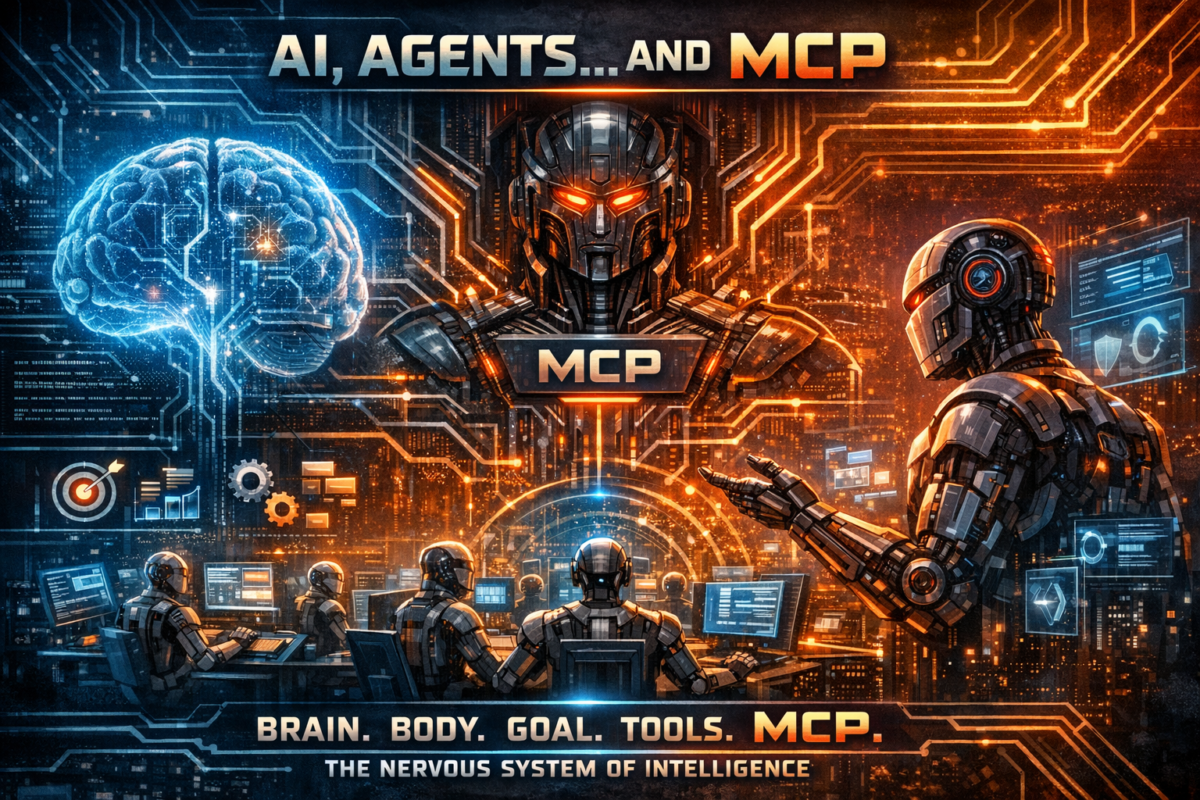
If the model is the brain
and tools are the hands
Protocols are part of the nervous system.
They reduce fragmentation.
They improve portability.
They enable cleaner integration.
This is what turns experimentation into infrastructure.
The Agent Stack
An AI agent is not just a model.
It is:
Agent = Model + Memory + Goal + Tools + Execution Loop (+ Coordination Layer)
Agents can:
-
Decompose problems
-
Execute subtasks
-
Evaluate intermediate results
-
Adjust strategy
-
Continue iterating until criteria are met
When structured correctly, agents shift from “assistant” to “operator.”
Not perfectly.
Not autonomously in every domain.
But meaningfully.
The Throughput Shift
In certain domains — software development, research synthesis, modeling, content production — the productivity compression is real.
Examples seen in practice:
-
Multi-day research condensed into hours
-
Prototype applications built in a single session
-
Marketing experiments executed in one afternoon
-
Operational workflows automated by one orchestrator
This doesn’t eliminate teams.
But it does change leverage.
What used to require:
-
Specialized departments
-
Extended timelines
-
Iterative coordination across roles
Now often requires:
-
A well-configured system
-
Clear constraints
-
Skilled orchestration
The shift isn’t universal.
But it’s structural.
Why There’s No Simple Reversal
When organizations experience:
-
70–90% cycle-time reduction
-
Lower execution cost
-
Faster iteration loops
-
Higher experimentation velocity
They don’t simply “go back.”
The architecture adapts.
Hiring changes.
Workflow changes.
Expectations change.
Once intelligence becomes embedded in systems,
it becomes assumed.
This mirrors prior infrastructure shifts:
Electricity.
The internet.
Cloud computing.
Not instant domination.
But irreversible integration.
What This Really Means
We are witnessing:
-
Intelligence embedded into software layers
-
Agents functioning as operational amplifiers
-
Protocols forming coordination standards
-
Humans shifting toward direction, oversight, and architecture
The central question is no longer:
“Can AI do this?”
It’s:
“How do we design systems assuming it can assist with this?”
That’s an architectural question.
And architecture shapes outcomes.
The Real Inflection Point
The inflection wasn’t when AI could talk.
It was when it could:
-
Reason across steps
-
Use tools reliably
-
Iterate toward goals
-
Integrate into workflows
That’s when AI stopped being a feature.
And started becoming a layer.
The Forward View
We are still early.
Many implementations are fragile.
Guardrails are evolving.
Regulation is catching up.
Human oversight remains critical.
But the direction is clear:
Intelligence is becoming programmable.
Execution is becoming compressible.
Coordination is becoming standardized.
The people who benefit most from this shift won’t be the fastest typists.
They’ll be:
-
Clear thinkers
-
Constraint designers
-
System architects
-
Strategic operators
Because when execution accelerates,
clarity becomes power.
We didn’t just cross a line with AI.
We began building systems past it.
And infrastructure,
once laid,
tends to stay.