
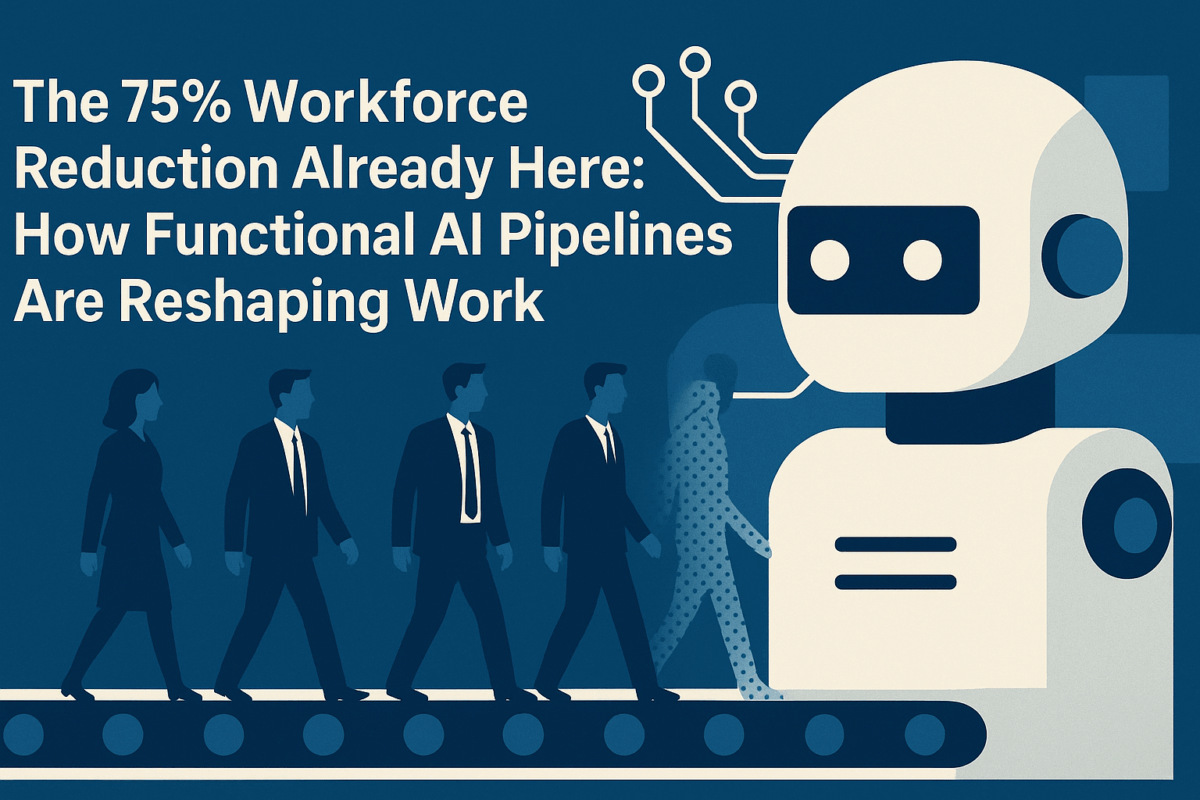
The numbers are staggering. Across small and mid-sized companies, we’re now seeing a realized 75% reduction in workforce after implementing functional AI pipelines, with estimates climbing as high as 80–90%.
This isn’t speculative. It’s happening today. Entire departments that once required teams of people are being compressed into streamlined AI pipelines that run in real time, learn as they go, and deliver results at a scale no human team could match.
A Real Example: Dentistry Meets AI
One of the clearest demonstrations came from work we did for a large dental office. Two departments—X-ray analysis and billing—were historically bottlenecks. Each had its own team, its own workflows, and its own piles of errors, inefficiencies, and missed revenue.
Here’s how functional AI pipelines changed everything:
1. Real-Time X-Ray Analysis
We implemented computer vision models trained on dental X-rays, both historical and real time. The models did more than flag anomalies—they uncovered thousands of missed opportunities for treatment that human analysts had overlooked in past records.
-
Before: a team of analysts manually reviewed every X-ray, often missing subtle patterns and burning countless hours.
-
After: the AI flagged issues instantly, highlighted areas of concern, and generated detailed reports. Analysts became reviewers, confirming or correcting results, not carrying the full load themselves.
2. Automated Notifications and Appointments
The AI didn’t stop at analysis. It triggered workflows that notified patients about pending treatments or follow-up appointments automatically. Patients who might have slipped through the cracks were contacted proactively, closing revenue gaps and improving care.
3. Billing & Insurance Automation
We deployed AI models into the billing pipeline to detect payment variances and insurance policy changes. Where human clerks once pored over paperwork and reconciliations, the AI parsed it all in seconds. It:
-
Flagged anomalies.
-
Suggested the correct billing pathway.
-
Auto-generated invoices.
Staff only had to intervene if the AI flagged something unusual. If a correction was made, the details were logged directly into our AI Substrate and the pipeline was re-run—training the model so the next cycle improved.
The Workforce Shift
The result? Dozens of roles collapsed into a handful. Employees no longer ran asynchronous, repetitive processes. Instead, they acted as quality controllers, affirming AI-driven outputs and guiding continuous learning.
-
In X-ray analysis, what once took a team of specialists now required only a couple of reviewers.
-
In billing, the back-office staff was reduced by more than half, with the remaining team handling only exceptions.
Across the board, the workforce reduction was 75% realized, with potential to push to 80–90% as the models continue to improve.
The Bigger Picture
This is just one example. The principle applies anywhere redundancy exists:
-
Healthcare: reviewing scans, automating intake, triaging.
-
Finance: reconciling payments, detecting fraud, processing loans.
-
Logistics: optimizing routing, scheduling, and inventory control.
Entire job categories—built on repetitive, asynchronous processes—are being re-engineered into functional AI pipelines.
Why This Matters
For businesses, the implications are enormous:
-
Cost savings are not marginal—they’re seismic.
-
Quality improves because AI doesn’t get tired or inconsistent.
-
Workforce focus shifts from low-value repetition to high-value oversight.
For workers, it’s a reckoning. The jobs that remain will require more judgment, adaptability, and comfort working with AI as a partner. The roles that disappear are those that AI can do faster, cheaper, and at scale.
A Future Already in Motion
This isn’t theoretical anymore. The aftershocks of a 75% workforce reduction are already being felt in real companies. The question isn’t if this transformation will spread—it’s how fast.
And for those already facing ballooning backlogs and rising costs, the choice is clear: either let AI pipelines carry the load, or risk being outpaced by competitors who already have.
The workforce of the future isn’t coming. It’s here, and it’s being reshaped pipeline by pipeline.